At Applus+ Laboratories we can provide you with our excellent medical device testing services, which help you improve the development and the compliance assessment to regulatory standards of your medical devices and their biocompatibility, while also checking the safety of your products. Biocompatibility testing is included with our other batch release testing services:
- Medical devices cleaning validation
- Medical devices package testing
- Medical device stability testing
- Chemical characterization for medical devices
- Particulate Testing for Medical Devices
Why biocompatibility testing for Medical Devices is important?
Biocompatibility testing for medical devices is essential to ensure that any material, component, or finished device that comes into contact with the human body does not trigger harmful biological responses. Through medical device biocompatibility testing, manufacturers can evaluate whether a device is safe, chemically stable, and suitable for its intended clinical use. This process is also central to demonstrating regulatory compliance, as global agencies require a full biological evaluation as part of device approval.
Biocompatibility tests for medical devices assess interactions between device materials and biological systems, ensuring the device does not produce cytotoxic, irritant, sensitizing, or systemic toxic effects. These evaluations form a foundational component of risk management and patient safety.
The chemical characterisation includes several parts of the standard ISO 10993:
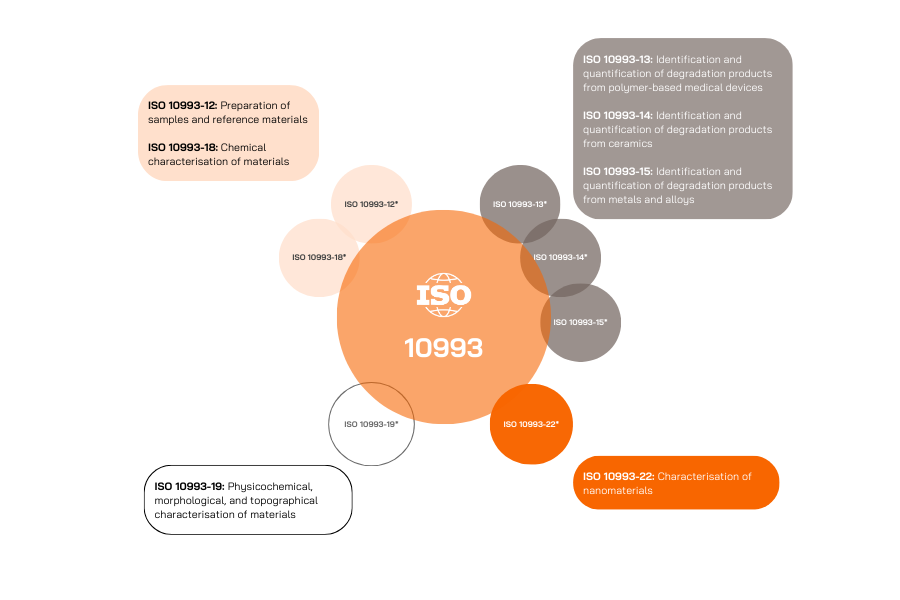
Guidelines to perform the biocompatibility assessment can be found in ISO 10993-1 and provides the required tests to be performed according to the type of device, the contact duration and the nature of contact with the body.
Special focus is required on the material potential to release compounds (associated to the manufacturing process, or the material degradation at its initial stage and after aging) to validate the expiry date.
Chemical characterization and extractables and leachables testing
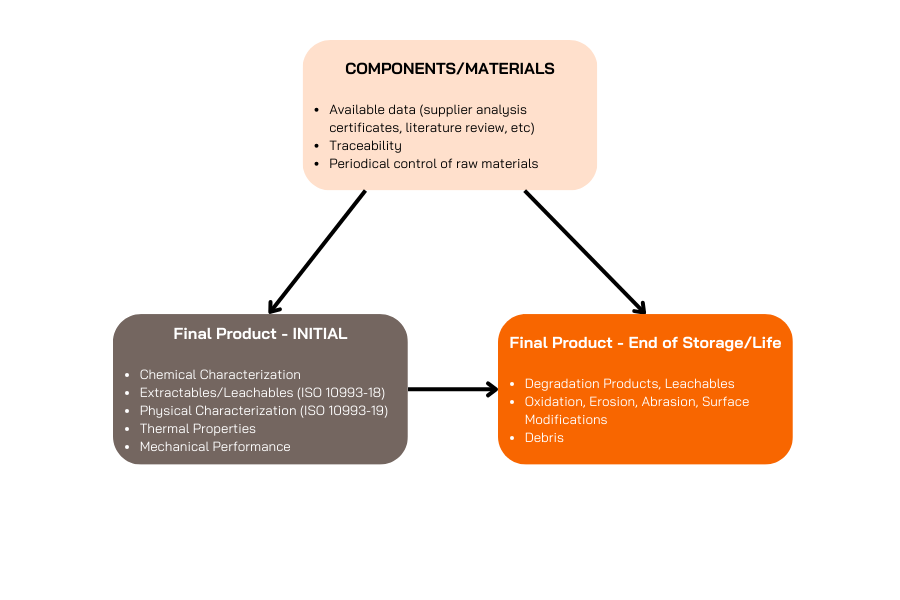
Characterising the material at its initial stage is important to determine the level of risk and releasing chemical compounds or uncontrolled products that could have an impact on the overall safety of the devices. This characterisation is the very first step in the elaboration of the biological evaluation strategy and requirement.
The determination of chemical characterisation after aging and the interaction of the medical device with its packaging is equally important to establish the shelf life and the determination of peremption date.
Physicochemical analyses according to ISO 10993-12 and ISO 10993-18
This initial analysis is focused on studying the physical and chemical properties of the materials used in medical devices.
All specimens of medical devices are extracted according to ISO 10993-12 requirements (depending on the nature of contact, duration, targeted market and chemical nature of the device).
The standard ISO 10993-18 provides guidance on identifying and quantifying chemical substances that could potentially be released from the medical device material, extractable and leachable substances, the chemical composition of the material and its chemical structure.
- Analysis of volatile compounds (VOC) such as residual solvent (terpenoid) and alcohols using Headspace gas chromatography (HS-GC-MS)
- Analysis of semi-volatile compounds (SVOC) such as residual monomer and low weight additives (alcanes, alcohols, ester,siloxanes…) using gas chromatography (GC-MS)
- Analysis of non-volatile compounds (NVOC) such as manufacturing and materials additives (high weight additive) using liquid chromatography (LC-MS)
- Analysis of mineral and inorganic compounds using ICP-OES and ICP-MS
- Analysis of ionic compounds (phosphate, chlorate, nitrate, bromide,…) using ionic chromatography (CI)
Physicochemical, Morphological and Topographical characterisation of materials according to ISO 10993-19
In addition to these compulsory assessments further chemical characterisation could be performed to better characterise your medical devices (FTIR, SEM, DSC, SEC). More detail in the chemical characterisation.
An essential part of the biological evaluation of medical devices, this process involves a comprehensive analysis of the physical, chemical, and surface properties of the materials used in medical devices to ensure their safety, performance, and biocompatibility. Understanding these properties will help you predict how the material will interact with biological systems.
The ISO 10993-19 standard covers many different dimensions, from the analysis of the elemental and molecular composition of materials to its thermal properties, the surface structure and morphology or the surface wettability and hydrophobicity.
Degradation product analysis (ISO 10993-13/14/15)
Another crucial aspect is to control the evolution of the device over time.
Uncontrolled degradation by-products and manufacturing product is ultimately something that needs to be verified to insure long term safety of the devices both in storage conditions and in living conditions
Through this process we can understand the long-term stability and safety of polymer-based medical devices, identifying and quantifying any by-products released as the material breaks down over time.
In this part of biocompatibility, stability testing is performed and similar tests as ISO 10993-18 are performed after aging. For metallic implant corrosion resistance and metallic leaching could be evaluated.
Regulatory compliance support for Medical Devices biocompatibility testing
Demonstrating compliance with international regulations is a critical part of the biocompatibility testing of medical devices. Regulatory bodies such as the FDA (United States), MDR (European Union), and other global agencies require a comprehensive biological evaluation aligned with ISO 10993‑1. Biocompatibility requirements testing for medical devices includes risk assessment, selection of appropriate biological tests, justification of test exceptions, and documentation of results.
Manufacturers must show:
- A complete chemical characterization
- An evaluation of extractables and leachables
- Compliance with biological endpoints required for the device’s classification
- A scientifically justified biological evaluation report (BER)
With our testing services, manufacturers have the tools to navigate the regulatory expectations efficiently, ensuring a smooth pathway to certification and market approval.
ISO 11979‑5 – Biocompatibility requirements for ophthalmic implants
ISO 11979‑5 is the key international standard governing the biocompatibility testing of ophthalmic implants, including intraocular lenses (IOLs) and other implantable devices used in eye surgery. Because these products come into direct contact with highly sensitive ocular tissues, this standard defines specific biological safety requirements that go beyond the general ISO 10993 framework.
This ophthalmology‑focused standard ensures that every material and component used in an intraocular implant is proven safe for long‑term use inside the eye. ISO 11979‑5 provides detailed guidance for evaluating:
- Ocular irritation and intraocular reactivity
- Cytotoxicity and systemic toxicity
- Extractables and leachables specific to intraocular exposure
- Long‑term ocular compatibility
By incorporating these dedicated requirements, ISO 11979‑5 helps manufacturers prove that their ophthalmic devices meet the highest standards of safety, purity, material stability, and biocompatibility. This standard is essential for regulatory submissions, risk‑management documentation, and market approval of intraocular lenses and other ophthalmic implants.
ISO 10993-5 – Cytotoxicity
The cytotoxicity test for medical devices evaluates whether materials or their extractables can cause cell death when they come into contact with living cells. Under ISO 10993-5, biocompatibility testing of medical devices includes in vitro assays exposing cultured cells to device extracts or direct contact materials to detect potentially harmful leachables. It is often the first screening step in the biological evaluation process due to its speed and sensitivity.
ISO 10993-10 - Irritation skin ensitisation
ISO 10993-10 defines biocompatibility testing of biomaterials and medical devices focused on dermal and mucosal responses, including irritation, allergic reactions, and sensitisation. These tests evaluate whether the medical device or its constituents can trigger inflammatory or immune-mediated responses after contact with skin or mucosal tissue. This is essential for devices with direct or prolonged patient contact, such as dressings, wearables, implants, or reusable instruments.
ISO 10993-11 - Potential systemic toxicity of Medical Devices
Systemic toxicity evaluations assess whether chemicals released from a medical device can produce harmful effects beyond the local application area. ISO 10993-11 testing includes acute, subacute, and chronic systemic toxicity endpoints. These biocompatibility tests for medical devices help identify risks related to absorption, distribution, metabolism, and excretion of potentially hazardous compounds.Biocompatibility
Biocompatibility testing for Medical Devices requirements
To meet global regulatory expectations, manufacturers must follow a structured, risk‑based approach defined by ISO 10993‑1. Depending on the device’s contact nature (surface, implant, external communication) and contact duration (limited, prolonged, long‑term), different biocompatibility requirements for medical devices apply.
Typical requirements include:
- Biological evaluation planning (BEP)
- Chemical characterization and toxicological risk assessment (TRA)
- In vitro and in vivo tests as needed
- Justification for omitted tests
- Shelf‑life and aging assessments
- Evaluation of manufacturing and sterilization impacts
- Final biological evaluation report (BER)
These requirements ensure the device is safe, performs as expected, and meets all biocompatibility standards necessary for market access.
Why choose Applus+ Laboratories for biocompatibility testing?
Choosing Applus+ Laboratories for your biocompatibility assessment aligns you with a distinguished leader in medical device testing. Our services, compliant with FDA requirements, and ISO standards, are specifically crafted to guarantee the structural integrity and safety of your medical device
- Fully equipped recent lab with the latest technologies
- Strong skills expertise on material evaluation
- Recognised and certified laboratories and employees
With operations across multiple countries, Applus+ Laboratories brings our leading-edge biocompatibility testing services to clients worldwide, ensuring accessibility to superior testing solutions wherever you are located.
We are a global company and thus we deliver our testing services anywhere in the world, providing top-tier biocompatibility testing to all our clients.
Trust Applus+ Laboratories as your dependable partner for biocompatibility testing. We stand ready to support your efforts with our extensive services and expert insights.